
The Hormone Steal Nobody Is Talking About
Cortisol, pregnenolone, and the hidden reason your sex hormones never had a chance… plus what to do about it starting today.
A while back I broke down the four stages of the hormone life cycle - production, circulation and action, breakdown, and elimination. The feedback I got was that it finally made sense. People finally understood what was happening in their bodies.
But I left something out.
I started at stage one. I explained what happens once production begins. I never told you what triggers it in the first place. And more importantly, I never told you what stops it before it ever begins.
Because for a lot of people, that is exactly what is happening. The signal never fully gets through. The raw material gets redirected. And the hormones the body was supposed to make - estrogen, progesterone, testosterone - never get made.
Today we go back to the very beginning.
Prefer to listen? This post is also a full episode on Real Healing with Elena - available on Apple Podcasts, Spotify, and wherever you listen.
Or watch the full episode on YouTube:
What Is Pregnenolone Steal? (The Short Answer)
Pregnenolone steal - also called cortisol steal - is when the body redirects its primary hormone-building raw material away from sex hormone production and toward cortisol instead. It happens automatically any time the body perceives stress, and it means your hormones can be depleted before stage one of the hormone life cycle ever begins.
This is the piece most hormone conversations completely skip. And it explains a lot.
The Ignition Switch
Before the body produces a single hormone - before any stage of the life cycle begins - there has to be a signal.
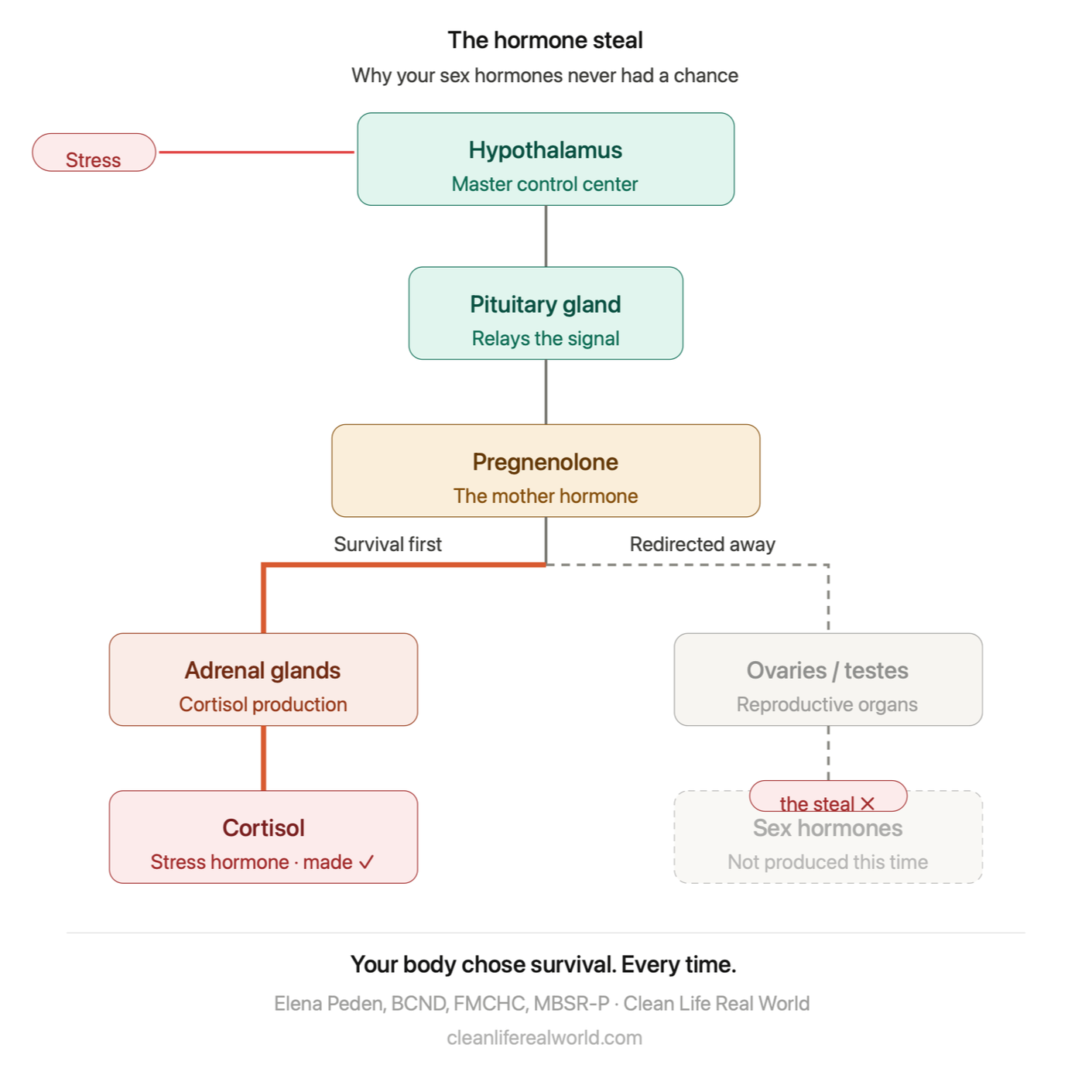
That signal starts in the hypothalamus. Think of it as the master control center of your entire hormonal system. It reads what the body needs and sends a message down to the pituitary gland. The pituitary receives that message and sends its own signals down to the organs and glands that actually produce your hormones - your ovaries, adrenal glands, thyroid, and for men, the testes.
That chain - hypothalamus to pituitary to target gland - drives your reproductive hormones (HPG axis), your stress hormones (HPA axis), and your thyroid hormones (HPT axis).
You don't need to memorize those terms. What matters is this: they all run through the same control center. The hypothalamus is managing all of them simultaneously, all day, every single day.
And that matters enormously because of what happens when that system gets overwhelmed.
The Steal
Here is where it gets critical.
All of your steroid hormones - estrogen, progesterone, testosterone, cortisol, DHEA - they all start from the same raw material. That raw material is called pregnenolone, often called the mother hormone, because everything downstream gets made from it.
Your body takes cholesterol - yes, you actually need healthy cholesterol levels - and converts it into pregnenolone. From there it makes whatever hormone it needs, based on the feedback coming from the hypothalamus.
Now here is where the steal happens.
Your body has a built-in hierarchy. Survival always comes first. And the hormone that keeps you alive under threat is cortisol. So when the body perceives stress - any kind of stress - it gets one signal: make cortisol. Now. And it redirects pregnenolone to do exactly that.
Because from the body's perspective, surviving this moment is more important than your menstrual cycle, your libido, your energy, or your mood.
This is called pregnenolone steal. In plain language: the raw material your body was supposed to use to make your sex hormones got used to make cortisol instead. Before stage one of the hormone life cycle ever began, the building blocks were already gone.
This is why women in chronic stress have hormonal chaos that has nothing to do with their age. This is why men lose testosterone not just from aging but from a body stuck in survival mode. The supply chain got hijacked upstream before production even started.
The Stress You Don't Know You're Carrying

When most people hear the word stress, they picture deadlines, hard conversations, financial pressure - the kind you can name and feel consciously.
But your conscious mind, the part you are actually aware of right now, represents only about five to seven percent of your total nervous system activity. The other 93 to 95 percent is subconscious - running in the background constantly, without your awareness.
And your body cannot tell the difference. It responds to subconscious stress the exact same way it responds to conscious stress. Cortisol. Fight or flight. Pregnenolone redirected.
So what is running in that subconscious background?
More than most people realize.
Your phone buzzes. Your Apple Watch taps your wrist. A notification pops up, then another. Your nervous system registers each one as - something requires attention, something might be wrong, stay alert. You eat lunch in your car. You scroll while you eat dinner. You fall asleep with the television on. Your body never fully comes down. It never gets the signal that says: we are safe, we can rest, we can restore.
The Stress Inside the Body
This is the piece that connects everything I talk about - and most people have never heard it framed this way.
Toxic burden is a stressor.
Mold. Heavy metals. Endocrine-disrupting chemicals - the pesticides, the plastics, the chemicals in your personal care products and cleaning supplies. Gut dysbiosis. Chronic low-grade infection. Inflammation. Your body is registering all of it as threat. Constantly. Silently.
You don't feel it the way you feel a panic attack or a hard conversation. But your nervous system feels it. Your hypothalamus feels it. Your adrenal glands feel it. And they respond the same way - make cortisol, stay alert, stay in survival mode.
This is why people can do all the meditation and breathwork in the world and still feel exhausted and hormonally wrecked. The stress isn't coming from their calendar. It's coming from inside the body.
It is also why cleaning the terrain - opening drainage pathways, reducing the toxic burden, healing the gut - is not just a physical health strategy. It is a nervous system intervention. When you reduce the toxic load, you reduce one of the biggest hidden sources of chronic stress your body is carrying every single day.
The hypothalamus gets quieter. The cortisol demand drops. And pregnenolone can start going where it was supposed to go.
You cannot meditate your way out of a body full of mold. But you can do the terrain work and watch your stress response change because of it.
(If you want to understand how the gut specifically connects to hormonal dysfunction, read this: The Gut-Hormone Connection Nobody Is Talking About.)
Sleep Is Not Separate From This
Cortisol is supposed to follow a rhythm. High in the morning to get you moving. Declining throughout the day. Low at night so the body can rest and repair.
When cortisol is chronically elevated, that rhythm breaks. High cortisol at night blocks melatonin - the hormone that signals your body it's time to sleep. So you lie there. Tired but wired. Mind that won't turn off.
And because you didn't sleep well, cortisol spikes again the next morning to compensate. Which keeps it elevated again that night.
This is not a willpower problem. It is a cortisol rhythm that has been disrupted by everything above, feeding a cycle that keeps itself going. Poor sleep also directly impairs the body's ability to produce and regulate sex hormones. So now you have pregnenolone being stolen, and a sleep debt driving the cortisol demand even higher.
This is why so many people in perimenopause feel like everything fell apart at once. It didn't. It built up over years. Sleep was one of the threads being pulled the whole time.
What You Can Actually Do
Not a full protocol. Just a few things you can start today that your nervous system will actually feel.
Deep belly breathing. Free, takes three minutes, works every time. True diaphragmatic breathing where the belly expands on the inhale - not shallow chest breathing. Even three to five breaths activates the vagus nerve, signals the body it is safe, and lowers cortisol in real time. Practice it at red lights. Before bed. When your mind starts to spin. Practice it when you don't need it so it becomes second nature when you do.
Grounding. Bare feet on the earth - grass, dirt, sand. Five minutes. The research on its effects on cortisol and inflammation is more substantial than most people realize. Can't get outside? Put both hands on a tree. Your nervous system will feel the difference.
Epsom salt baths. Magnesium is one of the first minerals depleted by chronic stress and essential for cortisol regulation, sleep, and muscle relaxation. It absorbs directly through the skin. Two cups of Epsom salts in warm water, two to three times a week. Add lavender. Turn the lights low. Make it a real experience.
Mindfulness in what you are already doing. Do the dishes without a podcast. Walk to your car and actually feel your feet on the ground. Go for a walk without your earbuds and notice what is actually around you. When you are fully present in a simple task, your nervous system reads it as safe. The constant background noise starts to go quiet.
Put the phone and the watch away. Not forever - just pick one time a day. Dinner with your family. The hour before bed. Give your nervous system the quiet it has forgotten how to have.
Ashwagandha is one of my personal favorites for cortisol support - an adaptogen that helps the body adapt to and regulate the stress response rather than just suppressing it. You can find what I actually use and recommend in my store.
And for anyone who has tried meditation and given up on it - which was me for a long time - I want to recommend a book that genuinely changed how I approach it: Stress Less Accomplish More by Emily Fletcher. It is not about clearing your mind. It's about giving your nervous system a real break. Every single person I have recommended it to has found it life-changing.
Bringing It All Together
Your hormones do not just appear. They are triggered by a signal from a control center that is managing your entire body simultaneously. When that control center is overloaded - by conscious stress, subconscious input, toxic burden, poor sleep - the signal gets rerouted. Cortisol gets the raw material. Your sex hormones don't.
And this is happening quietly, in millions of people's bodies, for years before a single lab marker ever shows anything unusual.
This is why I keep saying: disease begins long before diagnosis. Symptoms appear long before disease. The body is always communicating. We just were not taught to listen.
The information is yours. Go use it.
And if you want a decade of trial and error compressed into a clear guided path - with someone who knows how to read your body's signals and build a plan that actually addresses the root - that is what working with me does.
→ Watch the free training: Stop Managing Symptoms. Start Living.

Enjoy and Happy Healing!
Elena xoxoxo
Elena B. Peden, BCND, FMCHC, MBSR-P
Board Certified Naturopathic Doctor Clean Life Real World
Follow along on:
Instagram: @cleanliferealworld
Facebook: @cleanliferealworld
TikTok: @cleanliferealworld
YouTube: @cleanliferealworld
Podcast - Real Healing with Elena - Apple Podcasts | Spotify
About: Elena B. Peden is a Board Certified Naturopathic Doctor (BCND), Functional Medicine Certified Health Coach (FMCHC), and Mind Body Spirit Release Practitioner (MBSR-P) based in Houston, Texas. After investing over $100,000 in her own healing journey through mold toxicity and Lyme disease, she now helps people access their body's innate wisdom and reclaim their health sovereignty. She offers virtual consultations and online courses through Clean Life Real World.
Frequently Asked Questions
What is pregnenolone steal? Pregnenolone steal - also called cortisol steal - is when the body diverts its primary hormone-building raw material, pregnenolone, toward cortisol production instead of sex hormone production. Because the body prioritizes survival above all else, any perceived stress triggers this redirection. The result is lower estrogen, progesterone, and testosterone - not because the body can't make them, but because the raw material was taken before production could begin.
Can stress really lower your hormones? Yes. Chronic stress - both conscious and subconscious - keeps cortisol demand elevated. Because all steroid hormones share the same raw material (pregnenolone), high and sustained cortisol demand consistently pulls from the pool available for sex hormone production. Over time this shows up as hormonal imbalance, low libido, fatigue, mood disruption, and irregular cycles - none of which are caused by the ovaries failing, but by an overwhelmed stress response upstream.
What causes the body to stay in chronic stress mode? Most people assume chronic stress comes from life circumstances. But the nervous system also responds to toxic burden - mold, heavy metals, endocrine-disrupting chemicals, gut dysbiosis, and chronic low-grade inflammation. These are silent stressors the body registers as threat around the clock, without the conscious mind ever being aware of it. This is why lifestyle work alone often isn't enough, and why cleaning the physical terrain is a core part of hormone recovery.
How does sleep connect to hormone production? Cortisol and melatonin run on opposing rhythms. When cortisol stays elevated at night due to chronic stress, it suppresses melatonin production and disrupts sleep. Poor sleep then drives cortisol higher the following day, keeping the cycle going. This cycle also directly impairs sex hormone production and regulation - meaning sleep disruption is not a symptom of hormonal imbalance, it is one of the drivers of it.
What can I do to stop pregnenolone steal naturally? Supporting the nervous system is the foundation - deep belly breathing, grounding, Epsom salt baths, reducing digital input, and mindfulness practices all help lower cortisol demand. Addressing toxic burden through drainage support and detox reduces the hidden stressors signaling the hypothalamus. Targeted adaptogens like ashwagandha can provide additional cortisol regulation support. These are starting points - a bio-individual approach using muscle testing identifies the exact order and priority for your specific body.
Resources
Related Reading
Your Hormones Aren't the Problem. This Is. - The 4-Stage Hormone Life Cycle - the episode this post builds on directly
The Gut-Hormone Connection Nobody Is Talking About - how the gut drives hormonal dysfunction
The Clean Life Method - the full framework behind everything covered here
Work With Elena
Integrative Health Consultation - a 1-1.5 hour clinical assessment using muscle testing to identify your specific healing priorities
ReNew Healing Ecosystem - programs for every stage of the healing journey
Free Training - Stop Managing Symptoms. Start Living. - the full framework in 18 minutes
Muscle Testing
What is Muscle Testing - how I use it as the primary assessment tool in every consultation
Muscle Testing Simplified Courses - learn to use it yourself
References: Pregnenolone and steroidogenesis: standard endocrinology literature | HPA/HPG axis interactions: clinical endocrinology literature | Conscious vs subconscious mind: Lipton, B. - Biology of Belief | Grounding/earthing: Chevalier et al., Journal of Environmental and Public Health, 2012 | Magnesium and cortisol: multiple peer-reviewed sources | Ashwagandha as adaptogen: Chandrasekhar et al., Indian Journal of Psychological Medicine, 2012
Disclaimer:I am a board certified naturopathic doctor, not a medical doctor. Nothing in this post is intended to diagnose, treat, or replace care from your licensed healthcare provider. Always consult a qualified practitioner before beginning any new health protocol.